Unit 1: Health Assessment, Concept Mapping, and Medication Math
1.1 Overview | 1.2 Video | 1.3 Unit Learning Outcomes | 1.4 Health Assessment | 1.5 Concept Mapping | 1.6 Dosage Calculations | 1.7 Mastery Level Quizzes | 1.8 Conclusion | 1.9 References

1.1 Overview
Welcome to NURS 400 – Adult Health and Health Alterations. NURS 400 builds on your current knowledge of pathophysiology and treatment modalities to enhance your ability to provide competent, evidence-informed care to adults experiencing health alterations. The emphasis will be on all aspects of nursing management related to adult health and health alterations. It is expected that you have a foundational knowledge base in anatomy, physiology, pathophysiology, pharmacology, and medication calculations. If you identify learning needs related to the foundational processes, it is your responsibility to access resources for remediation. You are also challenged to become a reflective practitioner, aware of your personal learning needs. Continual reflection and honest self-assessment are important steps to continuing competency as a RN.
Please, refer to the Tutor News Forum for additional information on assignments and expectations posted by your tutor.
Please, also refer to the Med Math Module and the Health Assessment Module found on your course list; they enhance your learning for this course and are consistently referred to throughout the course.
1.2 Video
1.3 Unit Learning Outcomes
After completing Unit 1, you will be able to:
- understand the health assessment as a systematic framework that includes all aspects of your patient's health status;
- describe key elements of a health history and physical assessment;
- organize assessment data and nursing care priorities in a concept map;
- evaluate your knowledge and competence with medication math calculations;
- develop your personalized strategy to master medication math calculations; and
- define ongoing self-assessment with learning activities.
Let's Begin with Unit 1!
To begin, Unit 1 provides you the chance to review the elements of a health assessment. Each study guide unit will begin with a focus on the relevant health assessment related to the health alteration in the body systems. Consider the health assessment as a foundational and ongoing element in the nursing care and management of adults. A high-quality assessment that is ongoing and comprehensive is fundamental to anticipating a plan of care for the adult patient.
Concept mapping is one strategy some RNs use to organize care for acutely ill adults. Mapping out patient data requires nurses to sort and analyze information, make clinical decisions, and engage in clinical judgment. You are required to think differently as you transition to the RN role. Concept map care planning will help you achieve this goal. As well as being a guide for your care, concept maps help you identify what you do and do not know. For instance, when you see a change in a laboratory value, you can look at your map and ask yourself, "What is anticipated with this change?" This will be a cue for you to investigate why the value changed and to decide what can or needs to be done for the patient. This unit will introduce you to the concept mapping process of nursing care. Assignments 1 and 2 require the construction of a concept map. Please also refer to the Assessment Overview for specific guidelines and directions.
Unit 1 also includes an introduction to medication calculations.
1.4 The Health Assessment

Accurate and complete health assessment and data collection are prerequisites to the diagnosis, planning, and intervention steps of the nursing process (Lewis et al., 2014). An excellent assessment utilizes your knowledge, skills, and appropriate tools and techniques.
Ensure at a minimum that you can:
- describe steps in performing a physical assessment;
- complete a health history; and
- clearly and accurately document health assessment findings.
Learning Activities
Identify and choose the learning activities that would most benefit your review of the health assessment.
1. Review
Review Unit 1 chapter 5 in the course textbook related to completing a health history and physical health assessment. Practice the recommended health assessment techniques.
2. Review: Health History
Review what you know about conducting a health history and all of the components of the health history. Watch the video, Taking a Patient Clinical History and identify necessary components of the health history.
3. Review: Physical Assessment
A physical health assessment is a collection of both subjective and objective data, which are used to identify and evaluate problems or concerns that arise and assist the nurse with planning care (Jarvis, 2019).
Review the Health Assessment Module on your FHD Moodle home page. Try the activities related to checklists, crossword puzzles, and quizzes.
Review the specific techniques for assessment of each body system. Note the sequence of the assessment.
4. Locate
Consider guides you could use when completing a physical assessment. Locate some appropriate physical assessment guides and other tools you think will be helpful to you in NURS 401 and share your discoveries in the Unit 1 Forum.
5. Review
Review the CRNA Entry-to-Practice Competencies (2019) related to Assessment. Pick at least one competency and reflect on how you apply it in your present nursing practice. Feel free to share with your peers in the Unit 1 Forum.
6. Review
Review the following videos (and others you locate on this topic) and reflect on these questions: What are the differences between a focused assessment and a comprehensive (or complete) physical assessment? What strategies did the nurses use to make the assessment effective? How could the nurses enhance the quality of their physical assessment approaches?
Head to Toe Nursing Assessment
Nursing Simulation Scenario: Physical Assessment
7. Review: Documentation Standards
Assessment findings need to be documented in a clear, organized, and sequential manner. Read the CRNA Documentation Standards for Regulated Members (2013). Share what you learned about documenting in the Unit 1 Forum.
8. Reflection Moment: Stay Out of Court
Read Stay out of Court with Proper Documentation. Take some time to reflect on what you learned. Feel free to share in the Unit 1 Forum.
1.5 Concept Mapping Your Nursing Care

A nursing concept map is a graphic representation of related elements developed into a working plan for providing patient care (Schuster, 2008). RNs that use concept maps gather and logically analyze all data required for care for a patient and then "map" the components graphically. The visual aspect of concept mapping allows the nurse to physically “see” the connections between the elements of their patients condition and care tasks, and helps the nurse identify areas of missing information.
Consider all aspects of the person in planning and providing nursing care including physical and psychosocial aspects, family relationships, cultural aspects, and environmental elements.
Having a systematic method of connecting and organizing all relevant information about a person makes a difference in the quality of care you provide. Looking holistically at each patient potentially creates a sense of accomplishment for you as a RN.
A significant advantage of concept maps is that much important information is located all on one page! Viewing the connections between concepts and anticipating potential signs and symptoms is facilitated. The concept map is also a tool for the evaluation of care you provide.
Ensure at a minimum that you can
- reflect on your current processes for organizing patient care and consider improvements;
- define patient care concept maps;
- describe how concept maps are used in planning and organizing nursing care; and
- outline the advantages of concept map nursing care plans.
- A concept map starts with asking questions and data gathering.
- Who is this patient?
- What is their diagnosis?
- What is their health history?
- Gather all relevant data: Procedures, diagnostic results ie blood work, Xrays,
- What are their priority care needs? Make a list up to 8-12 nursing care priorities/ diagnosis.
- What are their psychosocial considerations? How are social determinants of health impacting the health outcomes?
- Reflection Moment: Take time to reflect
Concept mapping is a tool that helps with patient care organization and prioritization along with the learning and facilitation of critical thinking (Cottenie & Staempfli, 2016).
How can you improve the depth of your critical thinking? Feel free to share your thoughts in the Unit 1 Forum.
Do you want to know more about concept maps and enhanced critical thinking? Read Concept mapping as means to critical thinking.
- Here is an example of a concept map and care plan for a patient admitted with suicidal ideation including nursing priorities and interventions.
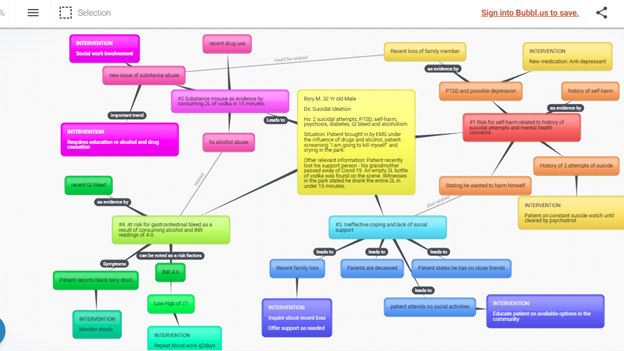
- The next step is creating a nursing care plan based on the top priority. This will be a requirement for both assignment #1 and #2. Remember, a nursing care plan includes only the top priority nursing diagnosis, a minimum one SMART goal, minimum three nursing interventions supported with credible and current sources of evidence, and minimum three evaluation statements. This nursing care plan is to be included as an appendix at the end of your paper.
Here is an example
Nursing Diagnosis: At risk for self-harm related to recent suicide attempt as evidence by patient overdosing on acetaminophen.Assessment
Goal
Intervention
Evaluation
- Previous attempt of suicide with medication
- Patient states he is severely depressed
During my 12 hour shift, patient will not cause himself or others harm and he will take his medications appropriately.
- 1:1 constant care provided for patient until psychiatric level 1 lifted
- Administer antidepressants as ordered
- Perform mental health assessments q4hrs
- Constant care is successfully positioned at bedside 1:1
- Patient agreeably takes his pills
- Mental health assessments q4hrs will show improving mental condition and no deterioration, suicidal ideation or confusion.
Here is a guideline for writing out SMART goals.

Format for writing actual health concerns:
P E S
(Problem or concern) related to etiology as indicated by signs and symptomsFormat for writing potential health concerns:
Potential concern or Risk factor(s): list all the factors which put the patient at risk for developing this problem).
* There are no signs and symptoms with a potential health concern.
Health concerns should be prioritized and can be written in your own words.Projected Outcome
Nursing Interventions
Rationale for each intervention
Evaluation
Projected outcomes
are the desired outcomes; they describe the behavior that the pt. is expected to achieve - the desired health stateShort term goals & objectives
Must be
S - specific, observable
M - measurable
A - accurate, achievable
R- realistic, focused on pt. behavior -
T- Include a time frame for the projected outcomeNursing interventions are the specific actions the nurse and/or pt. performs to achieve the projected outcomes.
The interventions are used to reduce or eliminate the cause or contributing factors to the health concern.
- Should be specific, measurable, and individualized for the pt.
- List all interventions that apply to the pt.
- Include actions the nurse initiates independently as well as actions that require a physician’s order (e.g. meds) or are performed in collaboration with other health professionals (e.g. chest physio)
- You may use your texts as a guide for developing care plans, but interventions must be specific and individualized for your pt.
- Remember that assessment is usually the first step with most health concerns.
- State specifically what assessments need to be made in relation to each health concernBe prepared to discuss the rationale for your nursing interventions with your Clinical Nursing Instructor.
Such as:
A theory-based rationale for each intervention from nursing textbooks.
Evaluation is a planned and continuous activity in which the nurse, pt., significant others, and other health care professionals are continually assessing the patient’s response to the interventions. Assessing patient response is done to determine whether the projected outcomes have been achieved and whether the interventions have been effective.
Each outcome should be evaluated separately.
Evaluation is ongoing as time passes the patient’s condition may improve or new problems may emerge.
The care plan must be modified accordingly (e.g., replanning must also be included).
- your current knowledge and competence in medication safety and drug calculations, and areas to develop competence as part of your BN scope of practice;
- the foundational principles of calculating medication dosages (for example reconstitution, intravenous drip rates, titration, weight based dosages); and
- your preferred method of completing dosage calculations (dimensional analysis, ratio method, formula method).
Learning Activities
Think about a patient you cared for recently and consider the answers to these questions.
Doodle the key findings from these answers into a beginning level concept map. Are there other questions that would be helpful to ask yourself as you develop a map to guide your nursing care?
Here is an example that further demonstrates how to link and label concepts to illustrate complex relationships for your assignments: (note that in this example, the main concepts are not numbered, which is a requirement for the assignments)

Supplemental Learning Activities
1. Find and watch some videos on YouTube about creating concept maps. Choose a component within the health assessment process that you find challenging and create your own concept map on this system. Share this with your peers in the forum; help them understand your thoughts your way. Keep this concept map for use in NURS 401 clinical practicum.
2. Explore these sites to create your concept maps for assignments #1 & 2
Bubble Mind Map | Cacoo
Mind Mapping Online - Bubbl.us
3.Check out these sites for help with your nursing diagnosis Nursing Diagnosis Guide for 2022: Complete List & Tutorial - Nurseslabs & 2022 Nursing Diagnosis Guide | Examples, List & Types (nurse.org)
1.6 Medication Safety and Dosage Calculations

Medication dosage calculations are an essential element of the safe administration of medications. You need to be competent in medication dosage calculations as part of your current nursing practice and the upcoming clinical practice experiences in this program. A foundational knowledge of dosage calculations is an expectation in beginning this course and will not be reviewed. You are responsible for seeking out and accessing appropriate resources to meet your learning needs. The emphasis in this course is on the critical application and analysis of medication dosage calculation principles to acute care adult patient scenarios.
The Medication Math Moments include patient case scenarios with medication calculations. You will find these case scenarios for practice in each course unit under Medication Math Moments. It is an opportunity for application and evaluation of foundational medication calculation principles within a simulated presentation of a patient typical of a NURS401 professional practice experience. The Medication Safety and Calculation Module in Moodle will provide you with resources for your self-directed learning journey in nursing medication math.
Ensure at a minimum that you understand:
Learning Activities
1. Practice Dosage Calculation Quizzes are available in the online textbook resources located in the Point.
2. Complete the Medication Safety and Calculations module. Ensure you are competent completing calculations related to each of the module units.
3. If you're learning needs are significant in this area, consider additional resources to meet your learning needs such as a med-math textbook.
Recommended math textbook: Buchholz, S. (2016). Henke's Med-Math: Dosage Calculation, Preparation & Administration (8th ed.). Philadelphia, PA: Wolters Kluwer.
4. Intravenous (IV) Fluid and IV Medication Administration
One of the nursing interventions that may be challenging is intravenous fluid and medication administration. If you are not competent in IV therapy, ensure you prepare yourself with the knowledge required.
5. Assessing your Learning
Complete the Case Studies Math Post-test in the Medication Safety and Calculations module. This practice test includes five case study scenarios similar to the two case studies in the final exam. Aim to achieve 100%.
1.7 Mastery Level Quizzes in Passpoint (Supplemental Activity)
Students are encouraged to complete NCLEX style mastery level practice quizzes in PassPoint or as part of your learning (please see Course Introduction: Course Materials: Recommended Online Resources). You will be able to track your performance in the How am I doing tab. You can then review your Chapter strengths & weaknesses. Based on these results, you may want to develop a learning plan to help you focus and manage your learning in this course. Mastery Level Quiz learning activities are suggested in each study guide unit.
The following instructional videos demonstrate how to use the Passpoint online resources and mastery quizzes.
Passpoint
All of you have varying professional experiences and knowledge, so a personal learning plan may help you to individualize your learning in this course. You may wish to include specific learning outcomes (what you need to learn), how you will accomplish each learning outcome (your learning strategies), resources you will use to achieve your outcomes, and how you will measure achievement of your outcomes. Ensure that you focus more on concepts and topics rather than on specific skills.
Keep Track of Your Achievements (PDF Version available here)
Nursing Topic |
Mastery Level |
Self-Score |
Self-Reflection |
Respiratory (example) |
6 |
65% |
Very comfortable with pathophysiology and management of COPD. More reading about ABG analysis is needed |
CV Disorders |
|
|
|
Oncologic Disorders |
|
|
|
GI Disorders |
|
|
|
Integumentary Disorders |
|
|
|
Immune & Hematologic Disorders |
|
|
|
Endocrine & Metabolic Disorders |
|
|
|
MSK Disorders |
|
|
|
Neurosensory Disorders |
|
|
|
Respiratory Disorders |
|
|
|
Genitourinary Disorders |
|
|
|
1.8 Conclusion

RNs must never stop learning. New medications, new treatments, new research findings are part of the work life of all RNs. To be successful, RNs need to be able to determine their own learning needs and take steps to address these.
Professional activities such as creating your own learning plan, which you regularly update throughout your career, may give you a road map to life-long learning.

andreabigbend. (2013, August 8). Creating concept maps using Microsoft word [Video]. YouTube. https://www.youtube.com/watch?v=uxyQPHAU7Cw
Austin, S. (2011). Stay out of court with proper documentation. Nursing 2011(4), 24-29. https://doi.org/10.1097/01.NURSE.0000395202.86451.d4
College of Registered Nurses of Alberta. (2013). Documentation standards for regulated members. https://nurses.ab.ca/media/zvhmc0yl/documentation-standards-for-regulated-members-jan-2013.pdf
Cottenie, K., & M. Staempfli (2016). Concept mapping as means to critical thinking. Teaching and Learning Innovations, 18. Retrieved from https://journal.lib.uoguelph.ca/index.php/tli/article/view/3548
Jarvis, C. (2017). Physical Examination & Health Assessment (3rd Canadian ed.). (A.J. Browne, J. MacDonald-Jenkins, & M. Luctkar-Flude, eds.). Toronto, ON: Elsevier Canada
Lewis, S. M., Heitkemper, M. M., & Dirksen, S. R. (2014). Medical-surgical nursing in Canada: (3rd ed.). Toronto, ON: Lippincott.
Montgomery College (2013). Nursing simulation scenario: Physical assessment (video). Retrieved from https://www.youtube.com/watch?v=CZ9M-2UdODg
Paul, P., Day, R.A., & Williams, B. (2016). Brunner and Suddarth's Canadian textbook of medical-surgical nursing (3rd ed.). Philadelphia, PA: Wolters Kluwer.
Schuster, P., M. (2008). Concept mapping: A critical approach to care planning. (2nd ed.). Philadelphia: PA: F. A. Davis.
Stamer, K. [NWIACOMMCOLLEGE]. (2010, May 13). Head to toe nursing assessment. [Video]. YouTube. http://www.youtube.com/watch?v=9Fxb8icOTOA
Ward, H. (2011). Taking a patient clinical history (video). Retrieved from https://www.youtube.com/watch?v=AH2IXVYXA80
Wilgis, M., & McConnell, J. (2008). Concept mapping: An educational strategy to improve graduate nurses' critical thinking
skills during a hospital orientation program. The Journal of Continuing Education in Nursing, 39(3), 119-26. Retrieved from http://0-search.proquest.com.aupac.lib.athabascau.ca/docview/223311284?accountid=8408