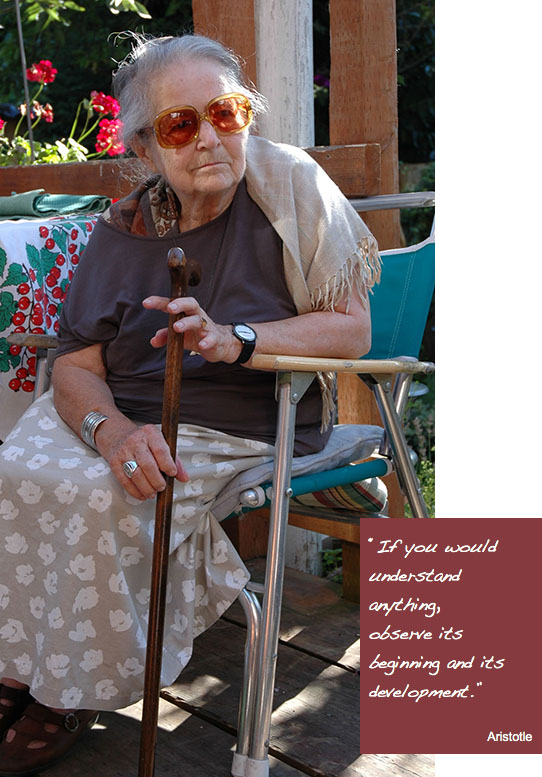
Developing an appreciation for the context that nursing has evolved in is imperative to understanding the present state of professional nursing. Culture, religion, era, and geography all influence the complex web that is the history of nursing.
In Unit 3, the highlights of the history of nursing in Canada will be reviewed and how these historical developments influence nursing practice today will also be examined.
Note: The unit number mentioned in this video is incorrect.
After completing Unit 3, you will be able to do the following:

What aspects of the history of nursing in Canada are significant? Do any of our current challenges relate to nursing history?
Context is critical. In some periods of nursing’s past, women did not have the right to vote or the right to
advanced education. Men may not have considered nursing as a valuable pursuit as it was considered to
be 'women's work'. Ideas from the turn of the century may be considered harsh but at the time, such
thoughts were considered revolutionary.
Read Reconsidering Nursing’s History during Canada 150 (Wytenbroek, & Vandenberg, 2017) https://www.canadian-nurse.com/en/articles/issues/2017/july-august-2017/reconsidering-nursings-history-during-canada-150 and view Claude Guilmain’s (2008) short, 8 minute film, Front Lines: Nurses at the front. https://www.nfb.ca/film/front-lines-nurses-at-the-front/. You may need to search for these resources. These images give the viewer a poignant look of some aspect of Canada’s nursing past. They give meaning to the idea of the context of nursing at the time. Not many of us will be able to say that we rode 26 miles on horseback to deliver a baby, or looked after an entire community as a student nurse, or wore outfits like that!
In Unit 3, there are four general themes in nursing history that will be explored. These themes mirror the headings of McPherson and Stuart’s 1994 article, Writing nursing history in Canada: issues and approaches. The themes are as follows: The Historical Relevance of the Term "Nurse"; Art and Science; Gender; Religion; and the State. Each of the forthcoming sections will ask you to post a response on a conference forum. You are expected to choose one of the four forums that interest you most and post your response.
To begin, read McPherson and Stuart’s (1994) classic article, Writing Nursing History in Canada: Issues and Approaches, found at the Canadian Medical History website https://www.utpjournals.press/doi/pdf/10.3138/cbmh.11.1.3.
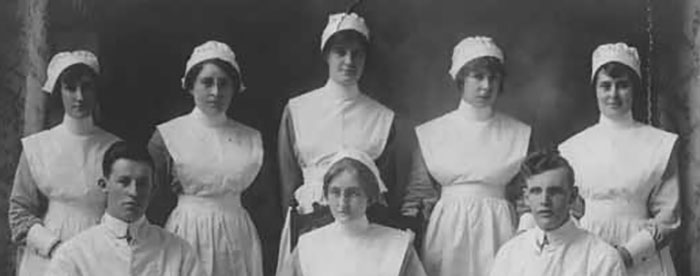
Victoria General Hospital Nurses Graduating class of 1899
In Canadian nursing history the term 'nurse' is heavily weighted. With it, warm thoughts of gentle, virtuous women who tend to the sick come to mind. They are clean, moral, just and conservative in presentation. Does this reflect the reality of nursing in the past or present and who or what is excluded from this idea? McPherson and Stuart (1994) question how there are no women of colour nurses in the pre-World War II era (p. 7), citing "a white female in uniform" (p. 5). Does this common historical image of a nurse influence present day nursing? For example, how would someone with a First Nations history describe a person who performed the roles of a 'nurse' in their community?
Where do the ideas of what a nurse is come from in your context? How has this influenced your choices? Ask three people from different parts of your life (such as, the person that works at the corner store, your accountant, the janitor at your child’s school etc.) what the term nurse brings to mind for them. Do the ideas people shared represent what nurses do? How are these ideas influenced by nursing’s past? Post your responses in the conference forum: 3.2 The historical relevance of the term 'nurse'.
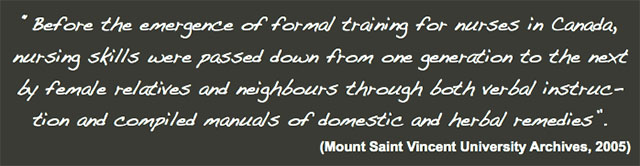
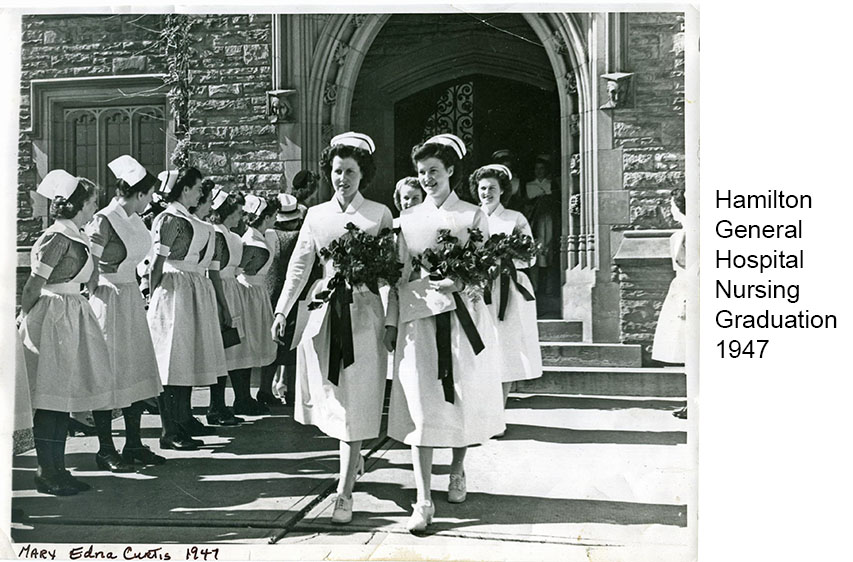
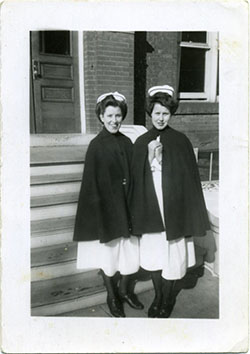
How much of nursing’s present and past is imbedded in "female virtues"? As noted in McPherson and Stuart (1994), Florence Nightingale said, "every woman is a nurse" (p. 10). Pat Armstrong, a health sociologist, suggested that according to Canadian nursing history, linking women across time. "Nursing work is women’s work". (McPherson & Stuart, 1994, p. 6). Is nursing women’s work? Could we just as easily consider that nursing virtues represent the qualities associated with being human? How does gender factor into and represent nursing today? Post your responses in the conference forum: 3.3 Gender.

As cited in McPherson and Stuart (1994), in 1924, CNA president Jean Browne warned of the dangers of "becoming a scientist and a teacher at the expense of tender ministrations to the sick" (p. 9). As nursing evolved the challenges posed by documenting both the abstract and concrete aspects of nursing became more relevant. "Was nursing work, 'Womanly or Scientific?'" (McPherson & Stuart, 1994, p. 9). What body of knowledge is unique to the profession of nursing? Would the concept of caring lead the way? If so, what does it mean to care? Would science represent nursing and if so, would the essence of nursing be lost? At times, the art and science of nursing were pitted against one another. Presently, most would agree that a balance is needed. How do you balance the two? Is the art and science of nursing at odds with each other? Post your responses in the conference forum: 3.4 Art and Science.
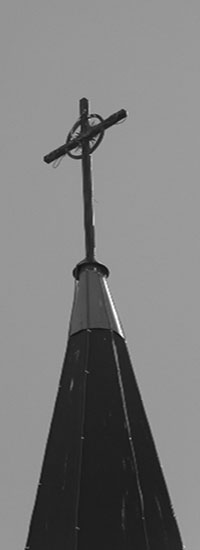
Canadian nursing history is tied rather tightly to its Christian religious past. Historically, in Canada, the act of 'nursing' was a tangled quagmire of virtues. Between pleasing God, serving society, and doing “womaen's work”, nursing was more than a full time job; it was a lifestyle. Florence Nightingale "envisioned nurses being 'trained to be handmaids of the Lord'" (as cited in McPherson & Stuart, 1994, p. 12). Rooting out dirt, disease, and moral disorder was all part of the package of nursing. "The essential characteristics of a 'true' woman (piety, purity, domesticity, and submissiveness) were believed to be perfectly expressed in the nurse" (McPherson & Stuart, 1994, p. 13). These quotes poignantly reflect how religion influenced the evolution of nursing in Canada.
From your experience, how does nursing’s religious past influence nursing today? Post your thoughts in the conference forum: 3.5 Religion and the State.
Over many decades, devotion and service faded somewhat and the inclusion of the state and the idea of pay became more relevant. Religious institutions had governance over the education and management of nursing; this was slowly taken over by secular institutions such as hospital authorities, health regions, and other government agencies. It is important to remember that in some cases this did not occur until the 1970’s (McPherson & Stuart, 1994).
The United Nurses of Alberta web site outlines their history spanning from 1900 to the present. These very brief segments outline some of the major milestones in the organization and unionization of professional nursing is Alberta. Go to http://charon.athabascau.ca/cnhsundergrad/250c6/docs/NURS%20250%20UNA%20History%20doc%20.pdf and read about six events that focus on nurse’s rights and wages.
Guilmain, C. (Director). (2008). Front lines: Nurses at the front [Video]. National Film Board of Canada. https://www.nfb.ca/film/front-lines-nurses-at-the-front/
McPherson, K., & Stuart, M. (1994). Writing nursing history in Canada: issues and approaches. Canadian Bulletin of Medical History, 11(1), 3-22. https://www.utpjournals.press/doi/pdf/10.3138/cbmh.11.1.3
Mount St. Vincent University Archives. (2005). Victoria General Hospital School of Nursing graduating class 1892 [Photograph].
http://forms.msvu.ca/library/tutorial/nhdp/Images/VictoriaGeneral/VGH_P7.jpg ***this photo was found in Mount St. Vincent University. (2005). Nursing history digitization project: Nursing education in Nova Scotia. http://forms.msvu.ca/library/tutorial/nhdp/history/university.htm
United Nurses of Alberta. (2013). The first 25 years. Strength in unity: History document. https://www.una.ca/files/uploads/2017/11/history2017.pdf
Wytenbroek, L., &Vandenberg, H. (2017). Reconsidering nursing's history during Canada 150, Canadian Nurse, 113(4), 16-18. https://www.canadian-nurse.com/en/articles/issues/2017/july-august-2017/reconsidering-nursings-history-during-canada-150
Last updated: November 09, 2021 ©
Copyright Athabasca
University
For questions, comments or to report broken links, email: CNHS Web